
Features
Bring your daily maintenance together
Batch repeated tasks, follow port activity, explore connections and share health findings. Five capabilities built around one familiar device list.
 — View larger
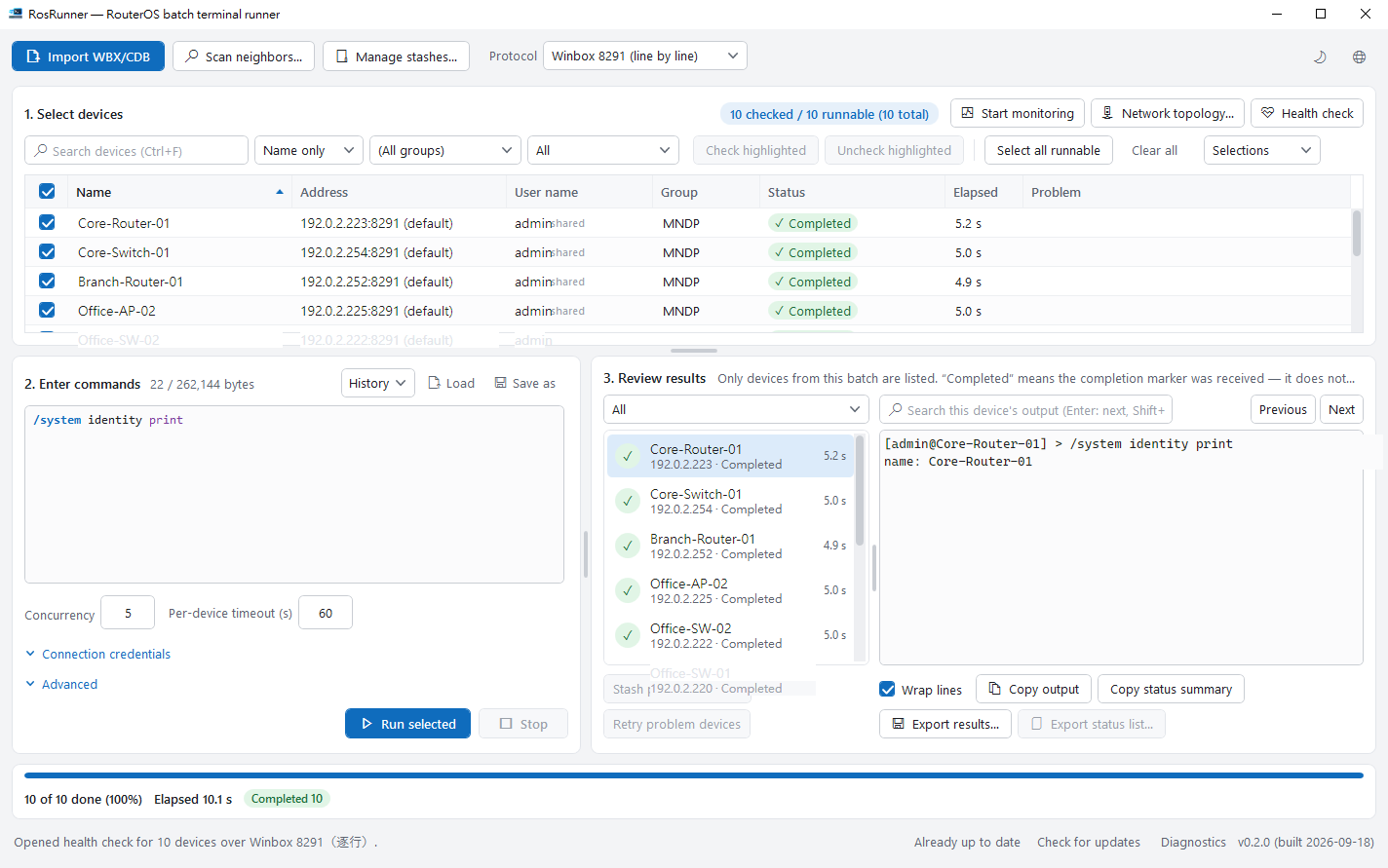
Write once. See the result for each device.
Send one set of commands to selected devices and review status, duration and output together. Confirm your targets before running and choose how many devices to handle at once.
Completed means a completion marker was received, not that every command achieved its intended effect. Query the device to verify a change. Uncertain results are never resent automatically.
 — View larger
Find what needs attention first
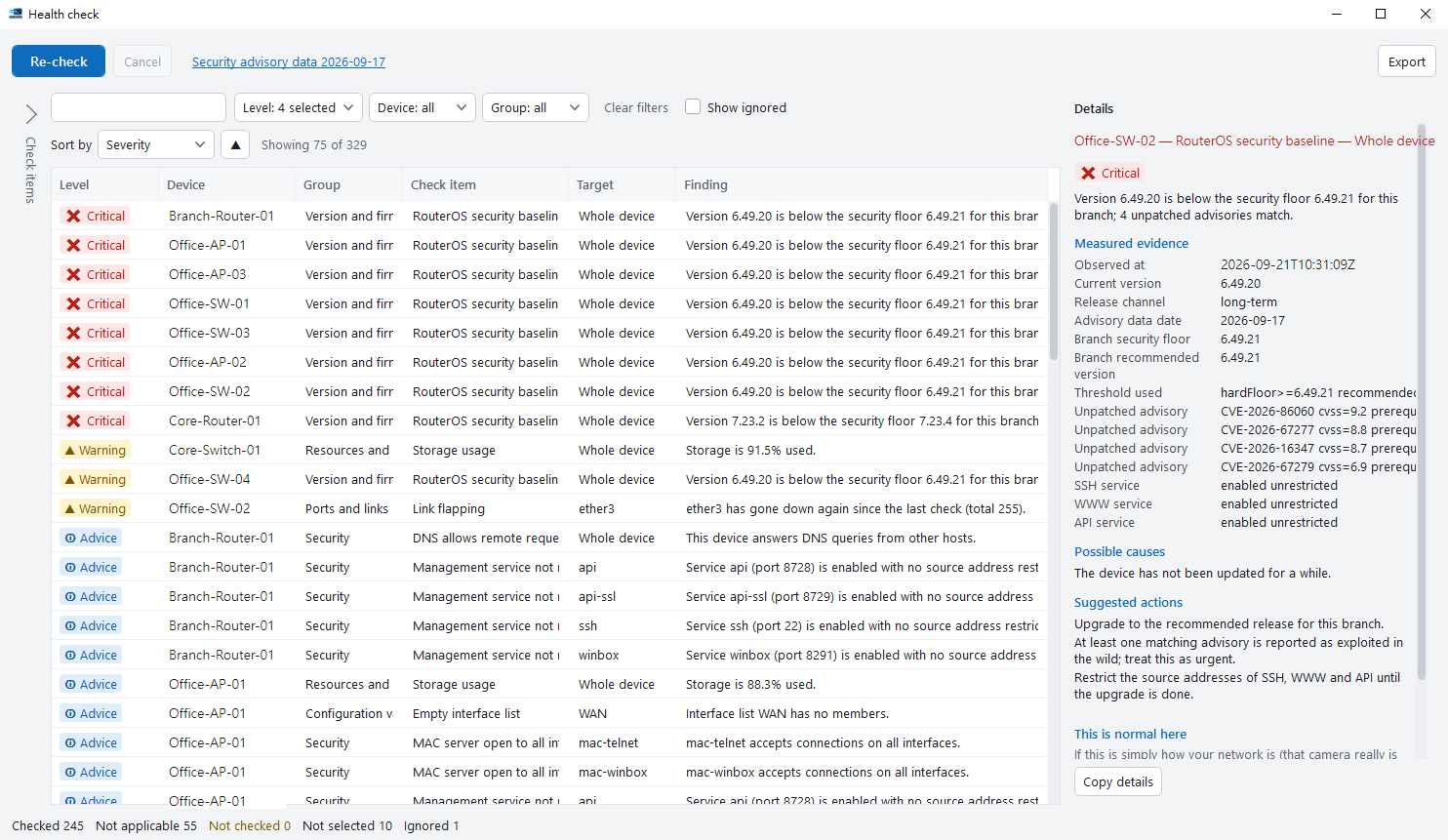
Turn eight groups of 31 read-only checks into findings backed by evidence and practical suggestions. Move from routine inspection to a report you can share.
Use measured values and suggestions to prioritize follow-up. Compare successive runs to spot changes.
 — View larger
See port changes at a glance
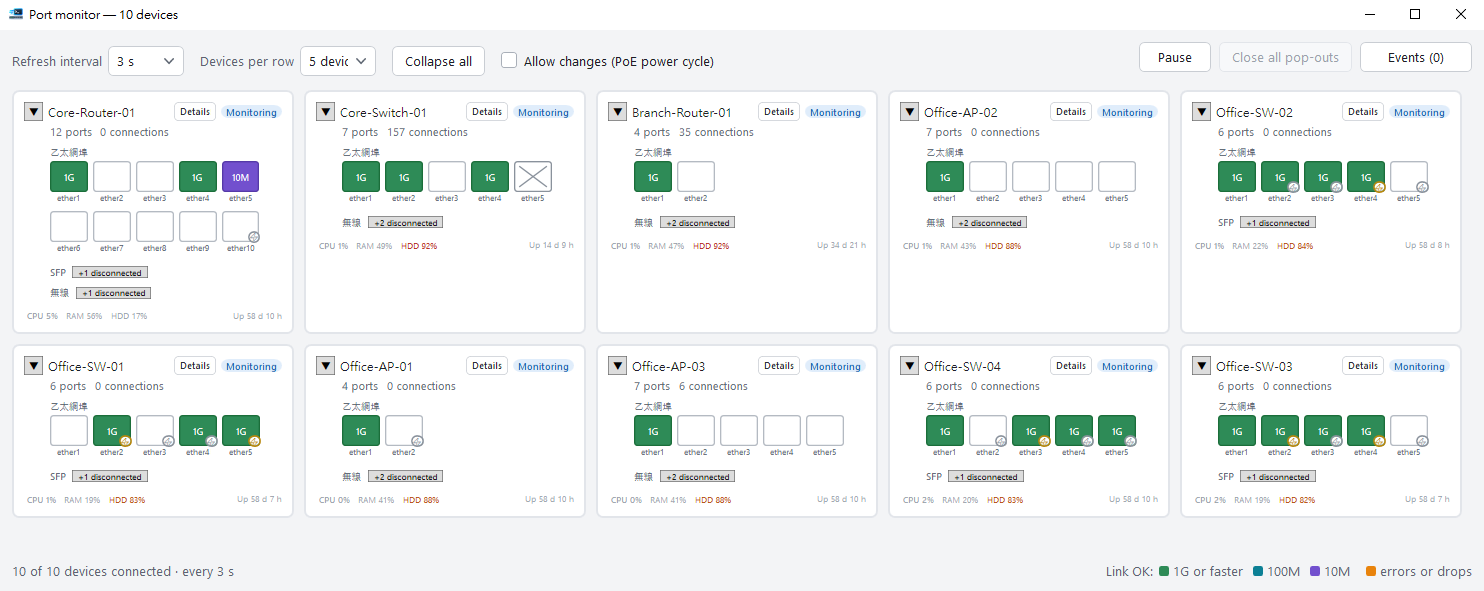
One card per device brings link speed, traffic, CPU and memory into view. Connect over 8291, with updates every three seconds by default.
Spot link-speed changes through color-coded ports. Review disconnects, reconnects and PoE changes on an event timeline.
 — View larger
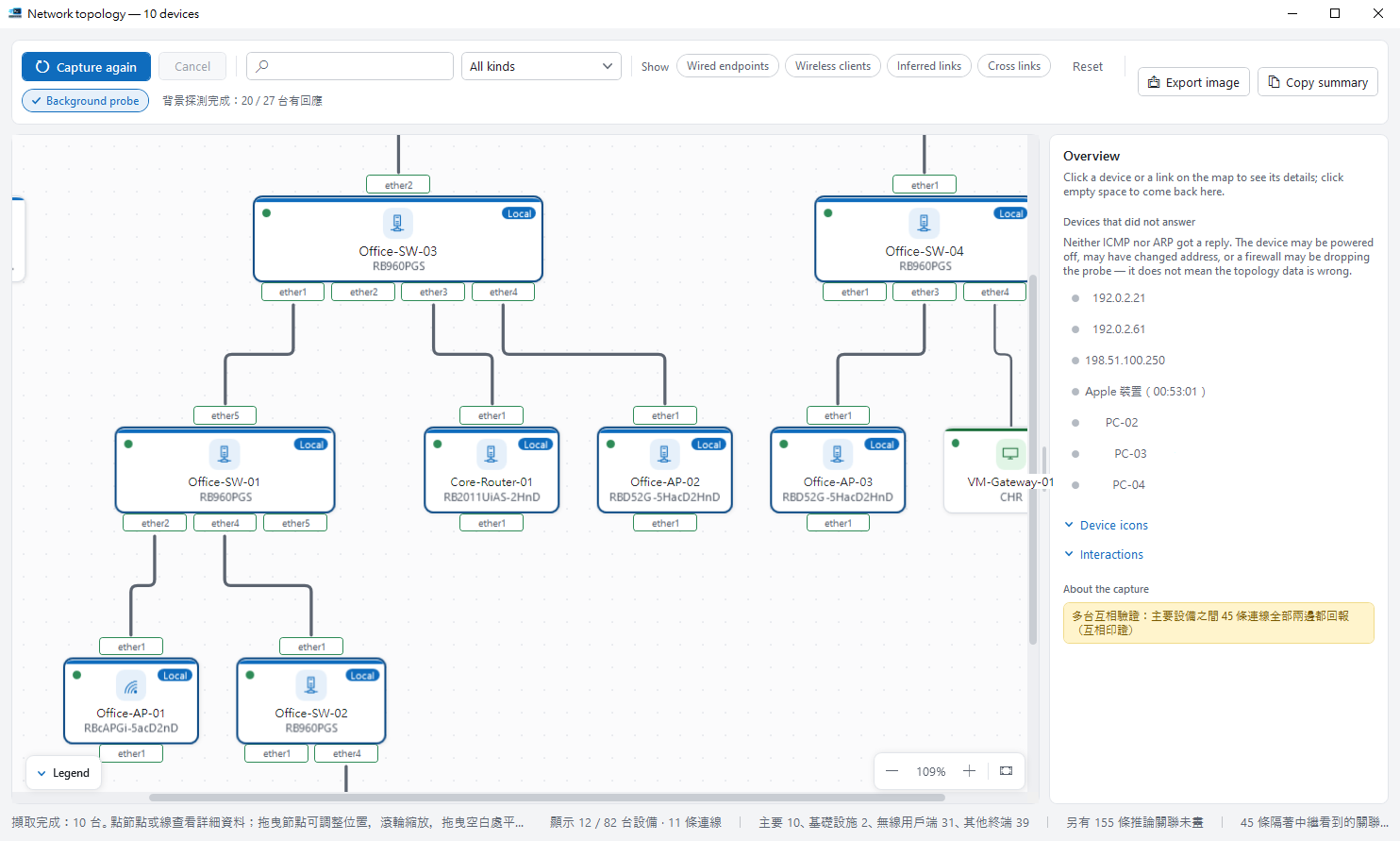
Bring device connections into one map
Combine connection information reported by multiple devices to explore an existing network, trace links and prepare handover notes. Coverage depends on devices, packages and permissions.
Read-only collection preserves existing device settings. Merge duplicate links and inspect node and port details.
— View larger
Maintain the device list
The address list you already maintain in WinBox imports directly, and devices on the same network segment can be discovered without knowing their addresses in advance.
Groups of devices you work with regularly can be saved under a name and recalled when needed, without reassembling the selection.
Real screenshot:Taken from the running application. Device names and addresses have been replaced with example values.
Start with 8291. Add other protocols only if needed.
WinBox 8291 is the primary connection and covers all four features below. API, SSH and REST are optional alternatives; their services only need to be enabled if you choose to use them.
| Capability | The connection WinBox uses (8291) | API (optional) | SSH (optional) | REST (optional) |
|---|---|---|---|---|
| Running commands | Yes (default) | 7.x only | Yes | 7.x only |
| Device audit | All 31 checks | Partial | Partial | Partial, 7.x only |
| Port monitoring | Yes | No | No | No |
| Network map | Yes | Yes | Yes | 7.x only |
Verified against RouterOS 6.49.x and 7.21.x / 7.23.x. SSH requires /ip service ssh to be enabled on the device; REST requires /ip service www or www-ssl, and is not present in RouterOS 6.x.

See how a run works in practice
The getting started guide covers adding a device, dispatching commands and interpreting the result, including the behaviour when a device does not respond.